

Lower back pain • Clinical Pilates • Singapore
Five Clinical Pilates Moves for Lower Back Pain
Updated: March 2026
Lower back pain is common. But common does not mean simple.
For many older adults, it slowly changes daily life. Getting out of bed becomes stiffer. Standing in the kitchen too long becomes tiring. Getting up from the floor, carrying groceries, bending to pick something up, or keeping up with grandchildren becomes less comfortable than it used to be.
For some families, the issue becomes obvious when a parent or grandparent starts saying things like, “I’ll sit this one out,” “You go ahead,” or “My back is not good today.”
For athletes and active adults, the story often sounds different but means the same thing. They may still train, but the back keeps tightening after runs, after golf, after tennis, after long workdays, or after heavier lifting. The pain may not stop training completely, but it changes how confidently they move.
That is why this page matters.
It is not here to promise that five exercises will fix every lower back problem. It is here to explain five commonly used Clinical Pilates movement ideas that can be useful in the right situation — and just as importantly, to explain when guidance matters more than self-prescription.
Clinical Pilates can help lower back pain when the problem is related to poor movement control, reduced trunk support, stiffness, or deconditioning. It is most useful when exercises are matched to the person’s stage, tolerance, and symptoms — not when movements are copied blindly.
What Clinical Pilates means in practical terms
Clinical Pilates is not just “normal Pilates with a more serious name”.
In practice, it means Pilates applied with more rehabilitation thinking behind it. The method may still use matwork or apparatus-based Pilates, but the decision-making is shaped by:
- pain behaviour
- movement quality
- posture and positioning
- tolerance to load
- stage of recovery
- what should be progressed and what should be left alone for now
That matters for lower back pain because the issue is often not just weakness. It can be a mix of:
- poor trunk support
- protective bracing
- stiff hips or thoracic spine
- breathing mechanics that increase tension
- loss of confidence in bending, rotating, reaching, or loading the body
The right movement can help. The wrong movement at the wrong time can irritate. That is why lower back pain should not be reduced to a random list of “best exercises”.
When these five moves may help
These movement ideas are most likely to be useful when someone needs to rebuild:
- gentle spinal mobility
- better trunk awareness
- hip support around the pelvis
- basic abdominal and back control
- confidence moving again
They are not meant as a blanket prescription for every lower back pain case.
Older adult example
An older adult may not describe the issue as “sports injury” or “core weakness”. They may simply say: “My back gets sore if I stand too long,” or “I feel stiff every morning and weaker getting up from a chair.”
Athlete example
An active adult or athlete may say: “I can still run / lift / play, but my lower back keeps tightening after training,” or “I am not badly injured, but I do not trust my back under fatigue.”
These are the kinds of situations where the movements below may be relevant — especially when introduced gradually and with good form.
Five Clinical Pilates moves for lower back pain
The five movements below are common starting points because they address different pieces of the lower-back-pain picture: trunk control, hip support, spinal mobility, abdominal organisation, and cross-body coordination.
1. Rotational stretch
This movement is often useful when the lower back feels stiff, guarded, or “locked up”, especially if gentle rotation feels limited.
What it may help with: spinal mobility, pelvic organisation, easing tension through the waist, hips, and lower back.
What the reader should understand: this is not about yanking the spine into a twist. It is about restoring comfortable movement and reducing bracing.
- Lie on your back with knees bent and feet on the floor.
- Open the arms out gently.
- Roll the knees to one side within a comfortable range.
- Pause briefly, then return to centre with control.
- Repeat on the other side.
Best for: people who feel stiff, compressed, or limited in gentle rotational movement.

2. The Clam (hip abduction support)
Many people with lower back pain are surprised that the hips matter so much. But weak or poorly coordinated glutes often leave the back doing more stabilising work than it should.
What it may help with: glute activation, lateral hip support, better pelvic stability.
- Lie on your side with knees bent and body stacked.
- Keep the feet together and lift the top knee slightly.
- Lower with control.
- Stay small and avoid rolling the pelvis backward.
Best for: people whose back gets irritated by walking, standing, or one-sided loading because the hips are not offering enough support.

3. Ab Prep
This is not about doing aggressive sit-ups. It is about waking up the abdominal wall and improving how the trunk supports the spine.
What it may help with: abdominal control, trunk organisation, support during everyday movement.
- Lie on your back with knees bent and feet grounded.
- Nod the head gently and lift the head / shoulders only within a manageable range.
- Focus on drawing the ribs and abdominals into support rather than yanking up.
- Lower with control.
Best for: people who need better trunk support but are not ready for stronger or more global abdominal loading.

4. Swan
Some people with lower back pain become overly flexion-based in how they move and sit. In the right case, a gentle extension-based movement like Swan can help restore balance and confidence.
What it may help with: spinal extension tolerance, chest opening, reducing excessive slumping, restoring supported extension.
- Lie on your front with legs long and hands near the shoulders.
- Use the arms lightly as you lengthen and lift the upper body.
- Keep the movement long rather than jammed into the lower back.
- Lower with control.
Best for: people who feel constantly rounded, compressed, or limited in extension — but only when extension is well tolerated.

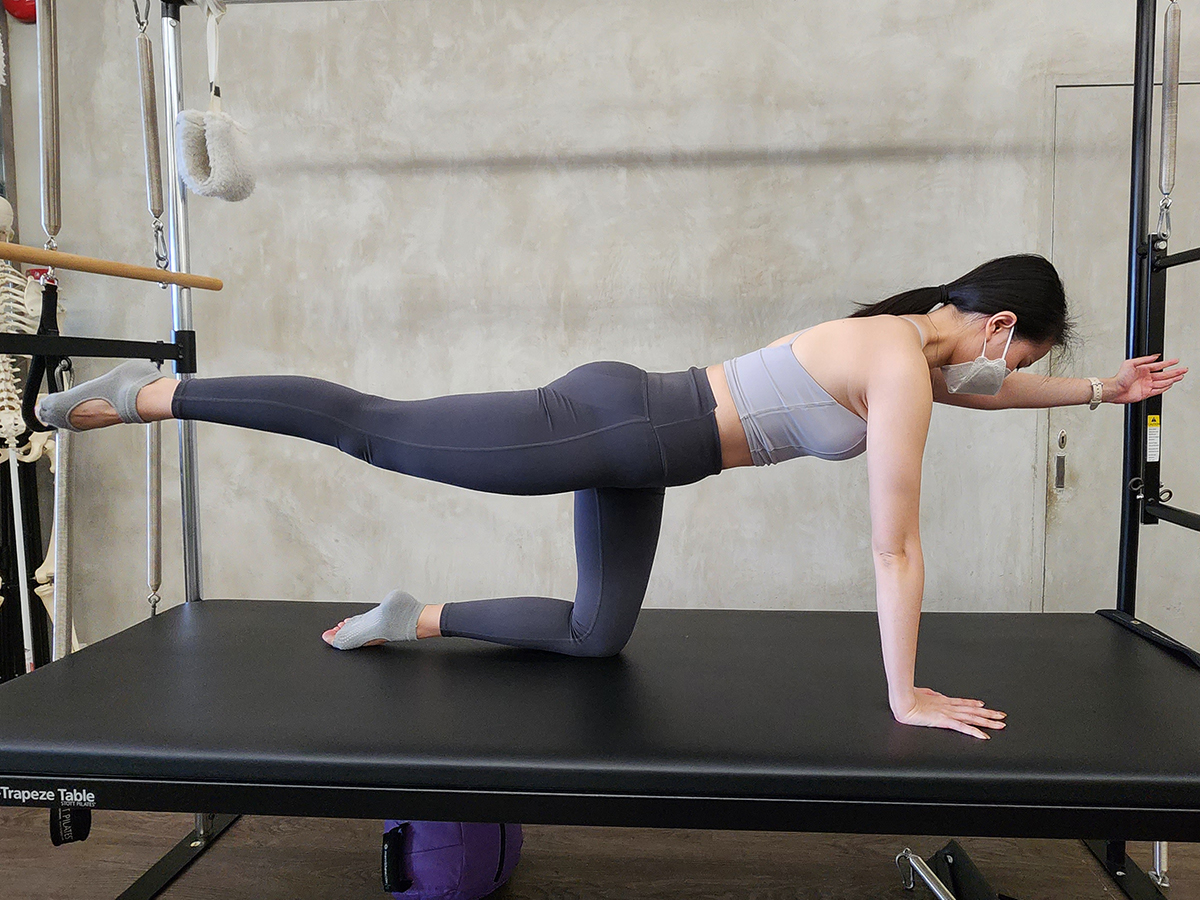
5. Kneeling arm with leg reach
This is a classic cross-body control exercise. It challenges trunk stability while the limbs move — which is closer to what daily life and sport actually require.
What it may help with: balance, trunk control, cross-body coordination, controlled spinal support.
- Start in four-point kneeling.
- Gently reach one arm forward and the opposite leg back.
- Pause briefly without collapsing or twisting.
- Return to start and alternate.
Best for: people who need to rebuild controlled stability without heavy load.
When not to self-prescribe these movements
This is where many articles become irresponsible.
If lower back pain is severe, worsening, unexplained, or linked to numbness, weakness, trauma, or major loss of function, guessing with internet exercises is not the right starting point.
You should also be more careful if:
- pain shoots into the leg strongly
- bending or extending is sharply aggravating
- the back “goes” unpredictably
- you have had a recent surgery or acute flare
- every exercise seems to make things worse
If you are unsure which movement is appropriate, it usually makes more sense to start with Rehab-Clinical Pilates or Private Pilates Sessions so the body is assessed properly rather than guessed at.
What to do next if lower back pain is affecting daily life
If lower back pain is beginning to affect:
- walking confidence
- standing tolerance
- training consistency
- work comfort
- play with children or grandchildren
- basic movement confidence
then the goal should not just be “more exercise”. The goal should be a more appropriate starting point.
Pilates for Back Pain
Best if you want a fuller explanation of how Pilates may help recurring lower back pain in Singapore.
Rehab-Clinical Pilates
Best if recovery, pain behaviour, or uncertainty about what is safe is central to the situation.
Private Pilates Sessions
Best if closer guidance, more tailored progression, and one-to-one instruction makes the most sense.
If you are not sure which movement is appropriate — or you are researching for a parent, partner, or yourself — start with a clearer clinical pathway instead of guessing.
Frequently Asked Questions
Can these five movements help every type of lower back pain?
No. They are common Clinical Pilates movement ideas, not universal prescriptions. Lower back pain can come from different drivers, and exercise choice should match the person’s symptoms, tolerance, and stage.
Are these movements suitable for older adults?
They may be, especially when introduced gently and appropriately. But older adults with recurring pain, stiffness, or reduced confidence often do better when exercises are guided rather than self-prescribed from the internet.
Can athletes use these movements too?
Yes. Athletes often need to restore trunk control, hip support, breathing mechanics, and confidence in movement — especially when the back tightens repeatedly after training or long workdays.
When should I start with Private Pilates instead of trying these myself?
If symptoms are easily triggered, recovery feels more complex, or you are unsure what your back actually tolerates, Private Pilates is often the better starting point because exercises can be selected and progressed properly.
What if my back pain is already affecting everyday life?
That usually means it is worth moving beyond generic advice. Start with a page like Pilates for Back Pain or Rehab-Clinical Pilates so you can understand the more appropriate next step.